Title: The Eagle's Shadow: Why America Fascinates and Infuriates the World
Author: Mark Hertsgaard
Publisher: Farrar, Straus and Giroux
Year of Publication: 2002
Number of Pages: 259
Do we simply dismiss him as a cheap sensationalist intent on selling books, or do we take him seriously?
Given room to cast a vote, Mark Hertsgaard, the author of The Eagle's Shadow, would certainly go for the serious bit. After all, he suggests strongly that the timing of his book, still being put together when the 9-11 attacks took place, makes it doubly important. Even auspicious.
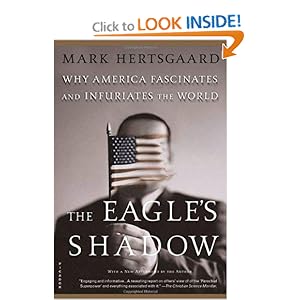
But exactly what is The Eagle's Shadow about? When I picked it up from the shelf at my local Book Trust shop earlier in the week, the cover didn't strike me as anything but another of the agitprop being churned generously by global Capitalism's fawning praise-singers. The cover design was bad enough. And then there was that Uncle-Samesque guy waving the American flag to make matters worse.
I thought I'd give it a try partly because Nadine Gordimer--herself a serious critic the various manifestations of the cultures of impunity--thought the book was "a strikingly original analysis of the American Dream at home and the ways it haunts the rest of the world." An initial look through the table of contents suggested that all America's sacred cows were up for some serious sniping at, and that too was quite a lure...
All in all, Hertsgaard's exposé on why America fascinates and infuriates the rest of the world did not turn up any major surprises, especially for those of us outside of America. The concentration of material wealth in America especially over the past half century would have reached our ears, even if Hollywood had not done such a wonderful job of over-emphasizing it. After all, American travellers around the world, like the big Texan in Hertsgaard's book, always find interestingly awkward ways to downplay what others have done by reminding us about how they've got "bigger and better ones" in Austin, San Antonio, New York, Chicago, and so on.
Some call it arrogance, but there is also a lot of truth in the author's claims that part of the problem is that those to whom these material acquisitions are flaunted are partly peeved because they do not possess these possessions. Or do not possess them in such abundance.
On a lighter side, perhaps Hertsgaard's odd anecdotal suggestion that there might be some people out there who think Americans are enjoying better--and more democratically spread-out---sex than the rest of us might carry some weight. Who knows?
On a lighter side, perhaps Hertsgaard's odd anecdotal suggestion that there might be some people out there who think Americans are enjoying better--and more democratically spread-out---sex than the rest of us might carry some weight. Who knows?
The book does a decent job of discussing America's excess consumption patterns, the insularity of its citizens--and this is directly related to how much influence that nation wields around the world--, its quixotic religious habits, and finally, its hypocritical stance as far as acknowledging widening internal class differences and the reality of being an empire extremely hostile to democratic values around the world (and increasingly at home). Hertsgaard's mining and deployment of current data out there on the various sub-issues are an added draw.
For instance, while most of us would know or would have met Americans who ask us whether Spain is in Mexico or would ask us to deliver a message to their friends in J'Burg when we get to Accra--since the two happen to be neighbourhoods in the same village called Africa--the hard stat that only 14% percent of Americans have passports, and only a fraction of that ever gets to use them, was juicy. So too were the stats about religious affiliations, publications of books, and the numbers of politicians who have to bow to powerful elements in the Religious Right in order to win power, and the terrible fates of those who dare to run afoul of the same establishment or their allies among the corporate elites.
Obviously, others have done similar work, and packaged it perhaps more eloquently. The greatest value of Hertsgaard's oeuvre is that he provides a timely reminder--circa 2002, but still relevant today-- which, sadly enough, would not be televised on Fox News/CNN/NBC/MSNBC and and the rest of the corporate media where the real America that needs to hear what he has to say lies, and is lied to.
For instance, while most of us would know or would have met Americans who ask us whether Spain is in Mexico or would ask us to deliver a message to their friends in J'Burg when we get to Accra--since the two happen to be neighbourhoods in the same village called Africa--the hard stat that only 14% percent of Americans have passports, and only a fraction of that ever gets to use them, was juicy. So too were the stats about religious affiliations, publications of books, and the numbers of politicians who have to bow to powerful elements in the Religious Right in order to win power, and the terrible fates of those who dare to run afoul of the same establishment or their allies among the corporate elites.
Obviously, others have done similar work, and packaged it perhaps more eloquently. The greatest value of Hertsgaard's oeuvre is that he provides a timely reminder--circa 2002, but still relevant today-- which, sadly enough, would not be televised on Fox News/CNN/NBC/MSNBC and and the rest of the corporate media where the real America that needs to hear what he has to say lies, and is lied to.
But having said that, we should also be willing to critique the major failings of The Eagle's Shadow. Although Hertsgaard occasionally makes passing references to it, he could have done a better job of showcasing the reasons that make people angry with America and its foreign policy decisions.
We of the rest of the world of both the retired terrorist--the author's expression--and ordinary citizen varieties do not appreciate the glories of America so much so often because we feel, with overwhelming hard evidence to support our feelings, that America is abusing its power and influence around the world.
We of the rest of the world of both the retired terrorist--the author's expression--and ordinary citizen varieties do not appreciate the glories of America so much so often because we feel, with overwhelming hard evidence to support our feelings, that America is abusing its power and influence around the world.
It is not Americans' pursuit of their legitimate dreams of happiness, etc. and even their attainment of that that infuriates us. It is the insistence of the American elite classes on building their so-called happiness on the immiseration of others that gets to us.
We don't like it when American politicians go about overthrowing or even killing our legitimately elected leaders.
We don't like it when they empower and strengthen all kinds of dictators who work against us and for the American elites' greedy interests.
We don't like it when they build their military bases on our soils and insist that they need to "destroy our towns and cities in order to save them."
We don't like it when they form criminal cartels like the WTO and use them to bully us into becoming hewers of wood and carters/cutters of stones meant for their edifices of arrogance.
We don't like it when American politicians go about overthrowing or even killing our legitimately elected leaders.
We don't like it when they empower and strengthen all kinds of dictators who work against us and for the American elites' greedy interests.
We don't like it when they build their military bases on our soils and insist that they need to "destroy our towns and cities in order to save them."
We don't like it when they form criminal cartels like the WTO and use them to bully us into becoming hewers of wood and carters/cutters of stones meant for their edifices of arrogance.
We may not be Americans. And some of us don't even want to be. But we think we have a right, like all humans on God's good earth, to pursue happiness. Strange as this may seem/sound, we have our dreams too. And often, American interventionism makes the pursuance of those dreams impossible.
And yes, we don't like it when American leaders who are some of the most illiterate concerning what happens outside the borders of their nation presume to preach to us about whom we should associate with, or how we should be organizing our lives.
And yes, we don't like it when American leaders who are some of the most illiterate concerning what happens outside the borders of their nation presume to preach to us about whom we should associate with, or how we should be organizing our lives.
Those of us in Africa, especially, are thankful to God for the beautiful things that ordinary Americans have been able to do for themselves. We admire the great and wonderful people that they have produced over the years. We read and enjoy/admire their Lincolns/Jeffersons/Paines/Thoreaus/Emersons/Whitmans and Twains/Steinbecks/Ellisons/Steins/Sontags/Dreissers/Faulkners and the longer cavalcade of the so-called minority writers. We admire ordinary Americans' work ethic, and we are happy for the many inventions they have blessed the world with.
But we aspire to add our own bit to the world heritage in our own ways. We don't need the avuncular pretensions of Uncle Sam to make that happen.
But we aspire to add our own bit to the world heritage in our own ways. We don't need the avuncular pretensions of Uncle Sam to make that happen.
Now, to my final verdict on Hertsgaard's book: In spite of all its shortcomings, The Eagle's Shadow is still worth all the two or three hours one may need to put into it because it redirects us to the debate about America's role in the world, and the consequences of that role.

